
Is your label ready? Three compliance changes Australian food & beverage manufacturers can't ignore
If you're a food or beverage manufacturer in Australia right now, chances are you have at least one labelling deadline sitting somewhere on your radar. PEAL has already passed, alcohol energy labelling is counting down, and 2D barcodes are quietly reshaping the supply chain. This guide breaks down what's changing, why it matters, and exactly what to do about it.
When you're operating a business in the incredibly busy environment of Food & Beverage Manufacturing, it can be hard to keep up with regulatory changes when you're focused on running a business.
We've pulled together everything you need to know about the latest labelling requirements and outlined practical steps for implementation.
No more technical terms: the end of confusing allergen labelling

For someone with a severe milk allergy, the difference between 'casein' and 'milk' on a label could be life or death. Yet for years, Australian food labels were peppered with technical ingredient names that even informed consumers couldn't decode.
In Australia alone, 1 in 10 infants, 1 in 20 children, and 1 in 50 adults are affected by food allergies. Trace amounts of allergens in food and drink can lead to anaphylaxis in some people and undeclared allergens are consistently the number one cause of food recalls in Australia, accounting for 57% of all recalls in 2024 alone. One of the most effective ways to prevent allergic reactions and anaphylaxis is clear, easy-to-identify labelling, so that affected people can make informed decisions about what they eat and drink.
That’s why in 2021, Food Standards Australia & New Zealand (FSANZ) introduced Plain English Allergen Labelling. Put simply, allergen information must be declared using plain English terms in bold font (in both the ingredient list and a separate 'Contains' summary statement) in a specific format and location on food labels.
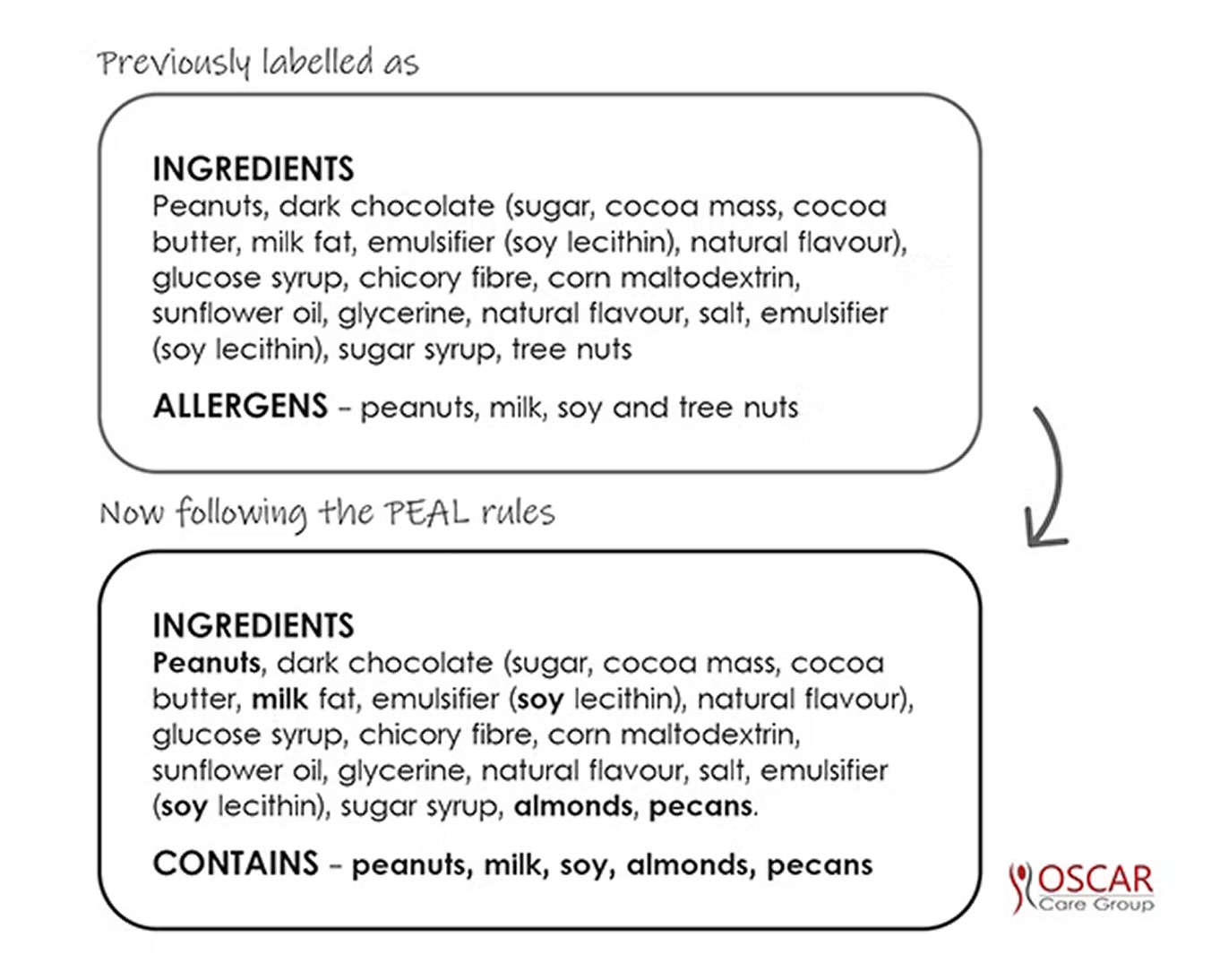
[Image source: Oscar Care Group].
PEAL became mandatory for all newly produced food from 25 February 2024, with a stock-in-trade period allowing older pre-existing stock to remain on shelves until 25 February 2026. That means the deadline has already passed, and it is now a legal requirement for all food and beverages on Australian shelves.
How to update your labels:
Audit all SKUs against the PEAL required names in Schedule 9 of the Food Standards Code
Bold every allergen in the ingredient list using the exact required name
Add or update the "Contains" summary statement in bold, adjacent to the ingredient list
Declare wheat AND gluten separately where applicable; name each tree nut and cereal individually
Review all processing aids for allergen content
Download the free FSANZ Allergen Labelling Poster
Use the NSW Food Authority Food Labelling Assistant tool
Download the free PEAL nutrition label template from BarTender
The requirements apply to all standardised alcoholic beverages (beer, wine, spirits, cider, RTDs, hard seltzers etc.) and any product containing 0.5% or more ABV.
With allergen labelling now firmly in the rear view mirror, the next deadline on the horizon is one that's caught many producers off guard.
Raising the bar on transparency: energy labelling for alcoholic beverages

Ask most people how many kilojoules are in their Friday night glass of wine and they'll have no idea, and until now, the label wasn’t going to tell them. Consistent and insightful energy information helps consumers make informed choices about their alcohol intake. Yet prior to these changes, only around 2% of alcoholic beverage SKUs voluntarily displayed energy information despite 69% of consumers supporting mandatory energy labelling on alcohol.
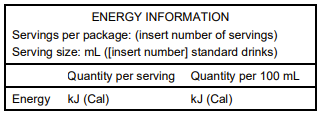
On the 13th of August, 2025, FSANZ gazetted changes to the Food Standards Code to mandate energy labelling on packaged alcoholic beverages. A new mandatory "energy statement" must appear on the labels of all packaged alcoholic beverages. It must include servings per package, serving size in mL, standard drinks per serving, energy per serving in kJ and Cal, and energy per 100mL in kJ and Cal.
[Image source: FSANZ]
The requirements apply to all standardised alcoholic beverages (beer, wine, spirits, cider, RTDs, hard seltzers etc.) and any product containing 0.5% or more ABV.
Right now, we are in the middle of the 3-year transition period. That means that both old and new labels are acceptable and alcohol manufacturers can update their labels at any time. A stock-in-trade exemption exists for all products packaged and labelled before the 13th of August 2028, so any stock already in the supply chain at the deadline does not need to be recalled or relabelled.
How to update your labels:
Confirm your product is affected (0.5%+ ABV, not already displaying a NIP, surface area over 100 cm²)
Use the free FSANZ alcohol energy content calculator to determine your product's energy values.
You'll need: ABV%, specific gravity, serving size (mL), servings per package, standard drinks per package, and any other energy-contributing components.
Consider whether space constraints will require a full label/artwork redesign (Wine Australia notes this is likely for many wine labels).
Use the transition window strategically - align label updates with your next scheduled print run to minimise cost
The FSANZ website has practical tools and resources to guide you through the changes.
While PEAL and energy labelling are about what's on your label, the next change is about what’s in your label.
Beyond the barcode: the quiet revolution in retail scanning
For decades, the humble 1D barcode has done one job: store a product identifier. Now, the retail and supply chain landscape has outgrown it. A 1D barcode can’t carry expiry dates, batch numbers, serial numbers, or web links, and it can’t tell a consumer where a product came from, flag an allergen, or surface a safety recall in real time.
Industry’s Ambition 2027 is a global initiative removing these limitations with 2D barcodes (QR codes and DataMatrix). These little squares can hold all of that data in a single code, scanned at POS exactly as a 1D barcode is scanned today. The same scan that processes a checkout can also give a consumer full product transparency on their phone, give a warehouse manager real-time batch visibility, and give a brand the traceability data it needs for regulatory compliance and recall management.
The initiative requires point-of-sale (POS) systems and retail scanners to be capable of reading 2D barcodes (QR codes, DataMatrix, or Digital Link formats) by 31 December 2027. Right now, this is a retailer/scanner infrastructure deadline, not a mandatory brand owner packaging requirement. However, after the deadline, 1D barcodes are expected to be phased out progressively as retailers start to direct brands to use 2D to keep their place on shelves. Early adoption is strongly encouraged: major retailers including Woolworths, Coles, Chemist Warehouse and ALDI are actively requesting suppliers begin transitioning.

[Image source: GS1]
To ensure compatibility with all retail environments until Sunrise 2027 is implemented, dual-marking is permitted during the transition period. That is, brands can print both a traditional 1D barcode and a 2D barcode on the same label.
The good news is that transitioning to 2D doesn't mean starting from scratch. It means being smart about your next print run. Here's what to work through:
Register or confirm your GS1 membership to obtain a GS1 Company Prefix (the foundation of any GS1 barcode)
Determine which 2D format suits your product: QR Code for consumer-facing products (easy to scan with smartphones), DataMatrix for small packages, Digital Link Uniform Resource Identifier (URI) for dynamic linking to web content
Decide what data to embed: at minimum, your GTIN. Consider adding batch/lot, expiry date, and a GS1 Digital Link URL pointing to your product information page
Use the GS1 Australia Sunrise 2027 readiness toolkit and free verification tools to generate and test your 2D symbol
Use dual-marking on your next label print run to maintain backwards compatibility with retailers not yet fully upgraded
Update your label and packaging design. Current layouts will not accommodate 2D barcodes without redesign. Key considerations: minimum size and quiet zones; account for substrate, print process, and surface type; real estate for dual 1D + 2D barcodes during transition; sufficient contrast (dark barcode on light background)
Upgrade your printing infrastructure: not all printers can produce high-quality 2D barcodes. Key requirements: minimum 300 DPI (600 DPI preferred for DataMatrix); thermal transfer printers are industry standard; variable data printing capability needed for batch, expiry, or serial data; print quality verification to ISO/IEC 15415 grading recommended for all products; ERP/WMS integration required for variable data print jobs
Check with major retail partners (Woolworths, Coles) about their specific timelines and any supplier requirements they have communicated
Three changes, one print run: your action plan
The lead time for a well-executed transition is longer than most teams expect. It can feel overwhelming, so we’ve collated three important actions and considerations that can make the entire process efficient for your team.
Roll all three changes into your next scheduled print run to avoid paying for three separate design, setup, and print runs. With PEAL already at deadline, alcohol energy labelling due by 2028, and 2D barcodes recommended before 2027, the smart move is to tackle all updates in one coordinated label refresh.
- Audit your label real estate early: the new "Contains" summary statement, energy table, and a 2D barcode all require physical space. Designs may need adjustment to ensure everything is legible and compliant. A label audit now prevents costly reprints later.
- Engage your label printer and graphic designer as soon as possible: lead times for label redesigns can be longer than expected, and compliance deadlines wait for no one.
Three regulations. One print run. The manufacturers who move first will spend less, stress less, and stay well ahead of the compliance curve.
Resources